


SAILOR
Static Analysis Informed and LLM-Orchestrated Symbolic Execution
SAILOR automates the hardest manual step in symbolic execution, writing the harness. Static analysis decides where to look, an LLM synthesizes the harness against compiler and KLEE feedback, and every result is replayed against the unmodified project under a sanitizer.
The problem
Symbolic execution is precise, but it needs a harness that sets up symbolic state, models dependencies, and states what to assert. Writing that harness by hand takes expert knowledge, which limits the technique on large codebases. LLM-only detectors scale, but they rarely produce evidence. They flag many issues, and few replay on the real binary.
How it works
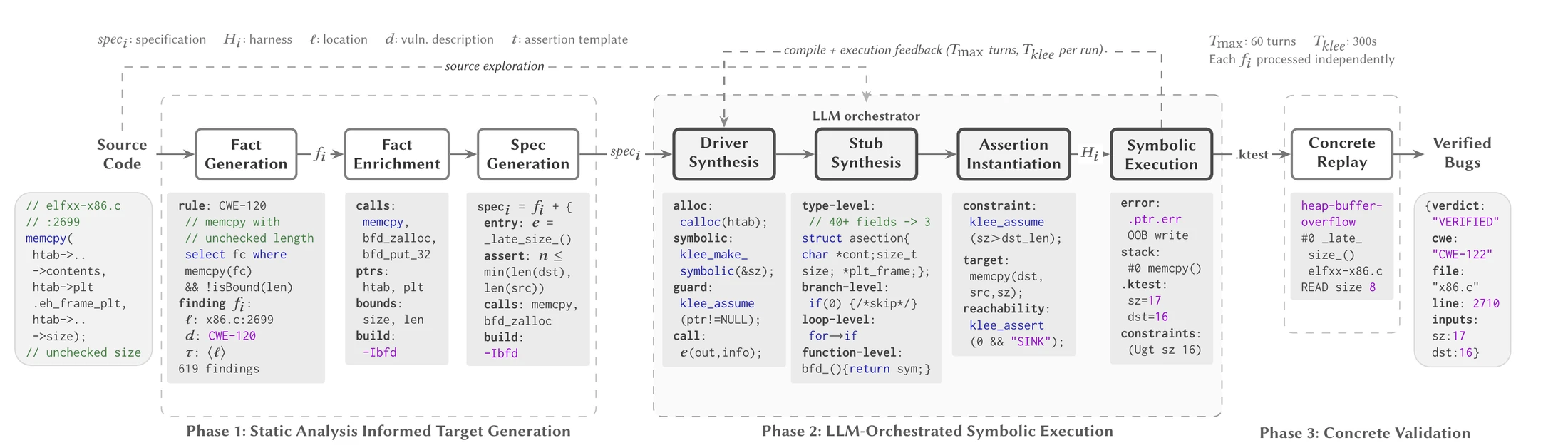
SAILOR runs three phases, and every phase hands the next one something checkable.
- Static analysis informed target generation. An extensible query system built on CodeQL finds candidate vulnerable locations and writes a specification for each one.
- LLM-orchestrated symbolic execution. An LLM iteratively refines drivers, stubs, and assertions against compiler and KLEE feedback. Symbolic execution then looks for a violating input.
- Concrete validation. The witness is replayed against the unmodified project under AddressSanitizer, so the LLM never decides whether a bug is real.
A worked example in SELinux
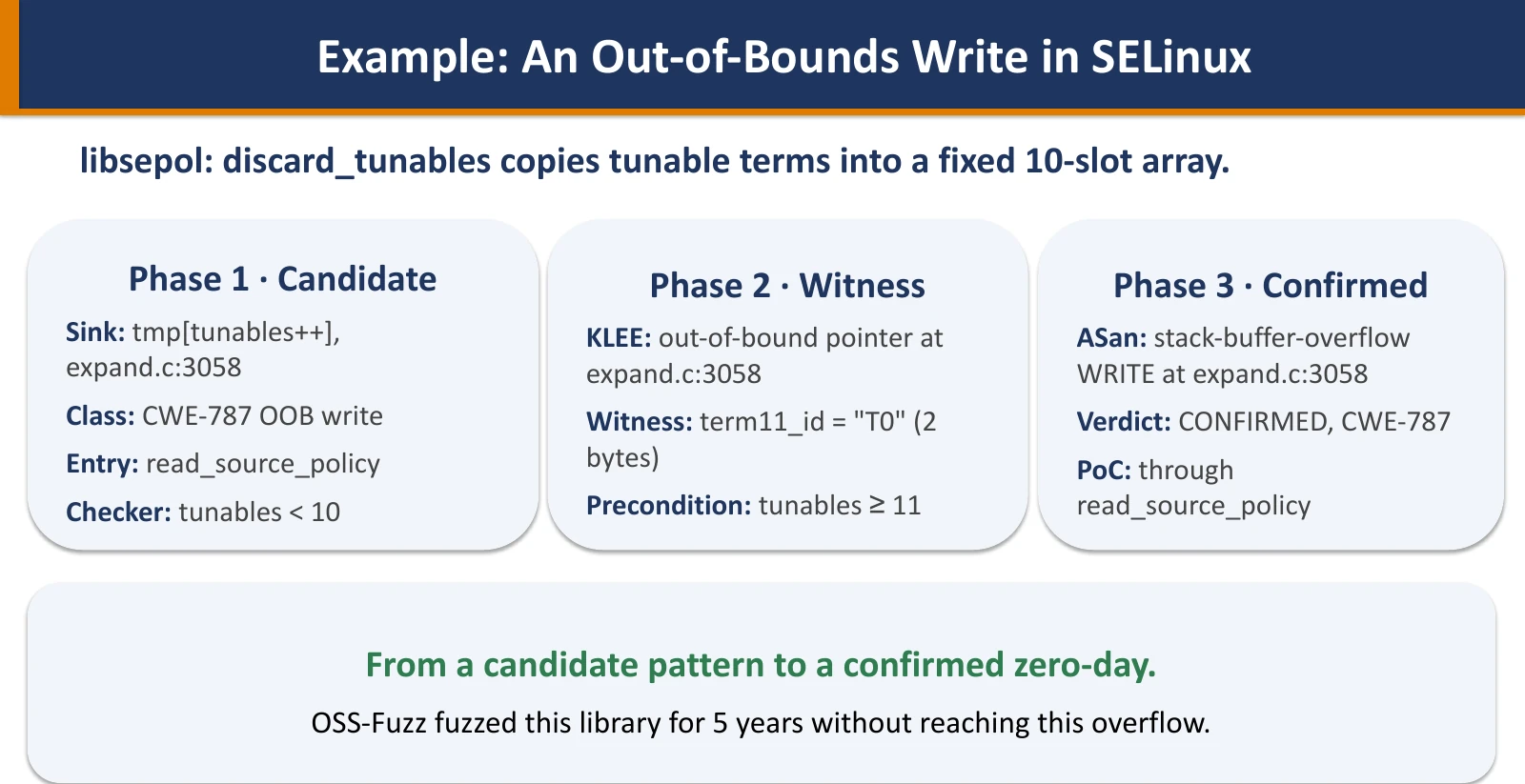
libsepol's discard_tunables copies tunable terms into a fixed 10-slot array. Phase 1 flags the sink and a checker (tunables < 10). Phase 2 has KLEE produce a witness, a policy with 11 tunable terms, through a synthesized harness. Phase 3 replays it against the unmodified source, and AddressSanitizer reports a stack-buffer overflow write at expand.c:3058. OSS-Fuzz had fuzzed this library for five years without reaching the overflow.
Results
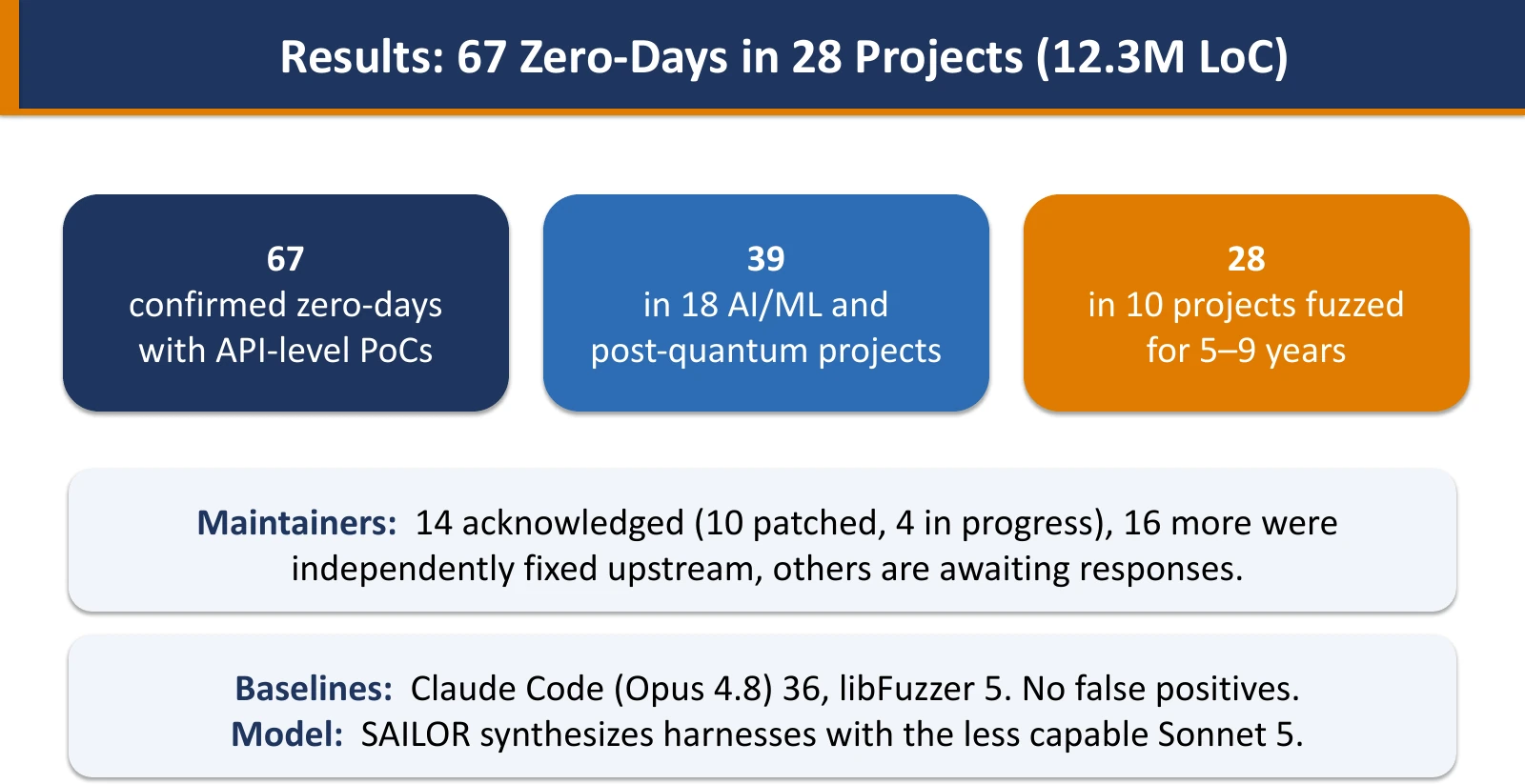
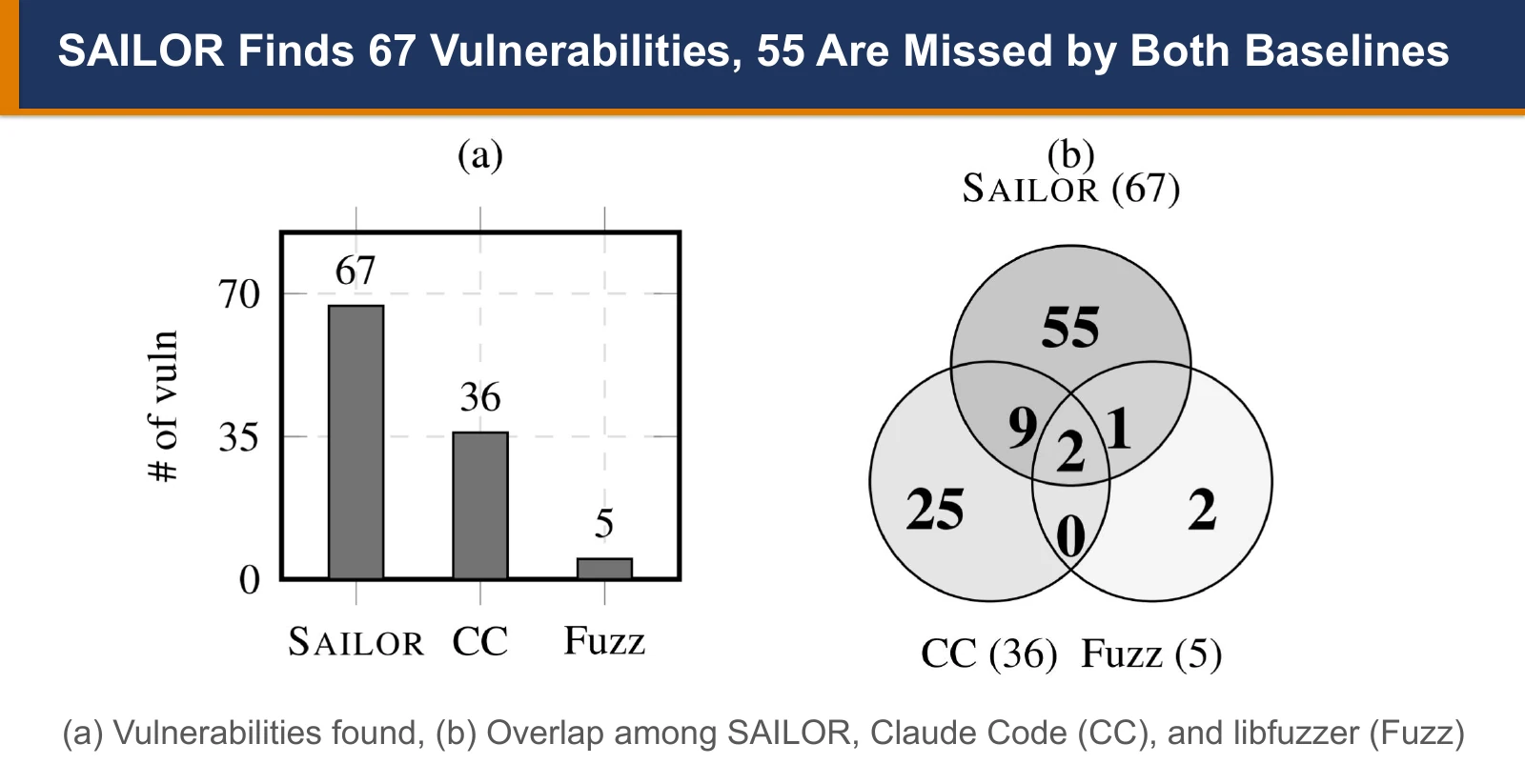
Run through public APIs on 28 real projects, SAILOR confirmed 67 vulnerabilities, and every one replays under AddressSanitizer on the unmodified project. Claude Code found 36 and libFuzzer found 5, and 55 of SAILOR's findings were missed by both baselines. Of the findings sent to maintainers, 14 are acknowledged (10 patched, 4 in progress) and 16 more were independently fixed upstream. SAILOR synthesized its harnesses with the less capable Sonnet 5, while the Claude Code baseline used Opus 4.8.
Every phase matters
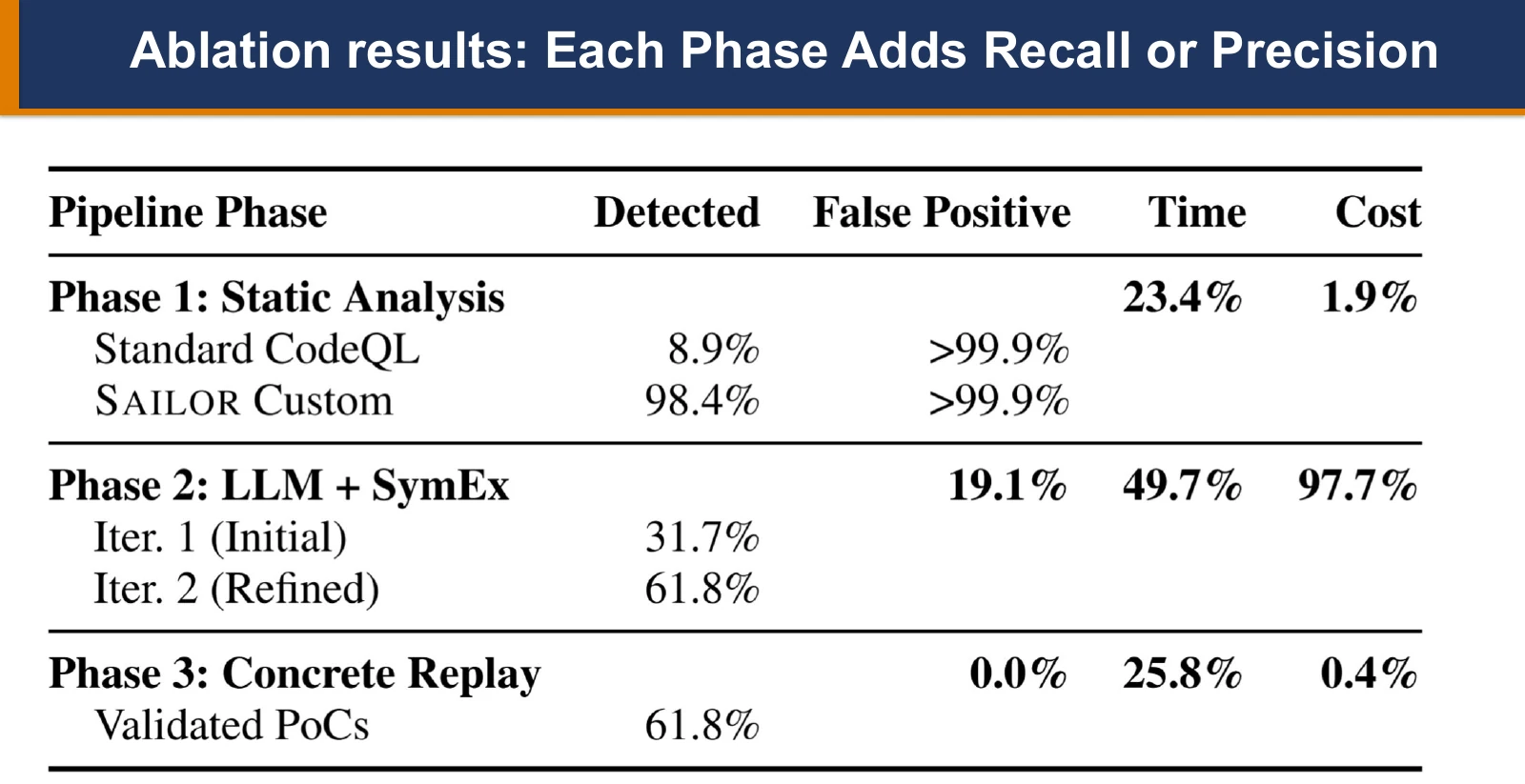
Removing a phase shows what each one contributes. Removing static-analysis targeting, the iterative LLM loop, or symbolic execution each sharply reduces the number of confirmed vulnerabilities.
Evidence
Every finding comes with a path constraint, a concrete input, and a sanitizer trace. Disclosed examples with advisories and merged fixes are listed on the Findings page. Reports still under coordinated disclosure are not shown.