


CHAINER
Discovering Vulnerability Chains with Memory-Aware Symbolic Analysis
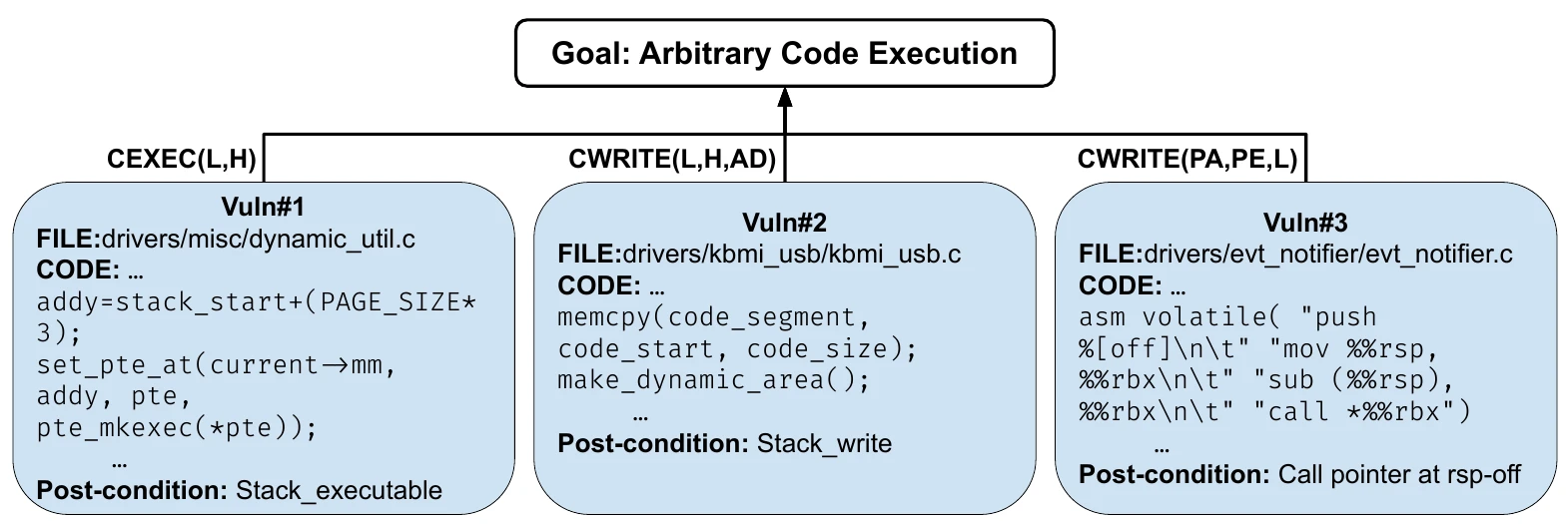
Bugs that look harmless alone can become a critical exploit when chained. A chain only works if the memory effects of each step line up, for example a stack that one bug makes executable, another bug fills with code, and a third bug jumps into. CHAINER reasons about that alignment, so it can tell which combinations of vulnerabilities are real.
The problem
Fuzzers, static analyzers, and symbolic executors look at vulnerabilities one at a time. Only a small share of reported bugs are critical on their own, yet chaining low and medium severity bugs can give arbitrary code execution or privilege escalation. The hard part is memory alignment. Two bugs only compose if they act on overlapping address regions, so a chain needs a precise model of where each bug reads, writes, and executes.
How it works
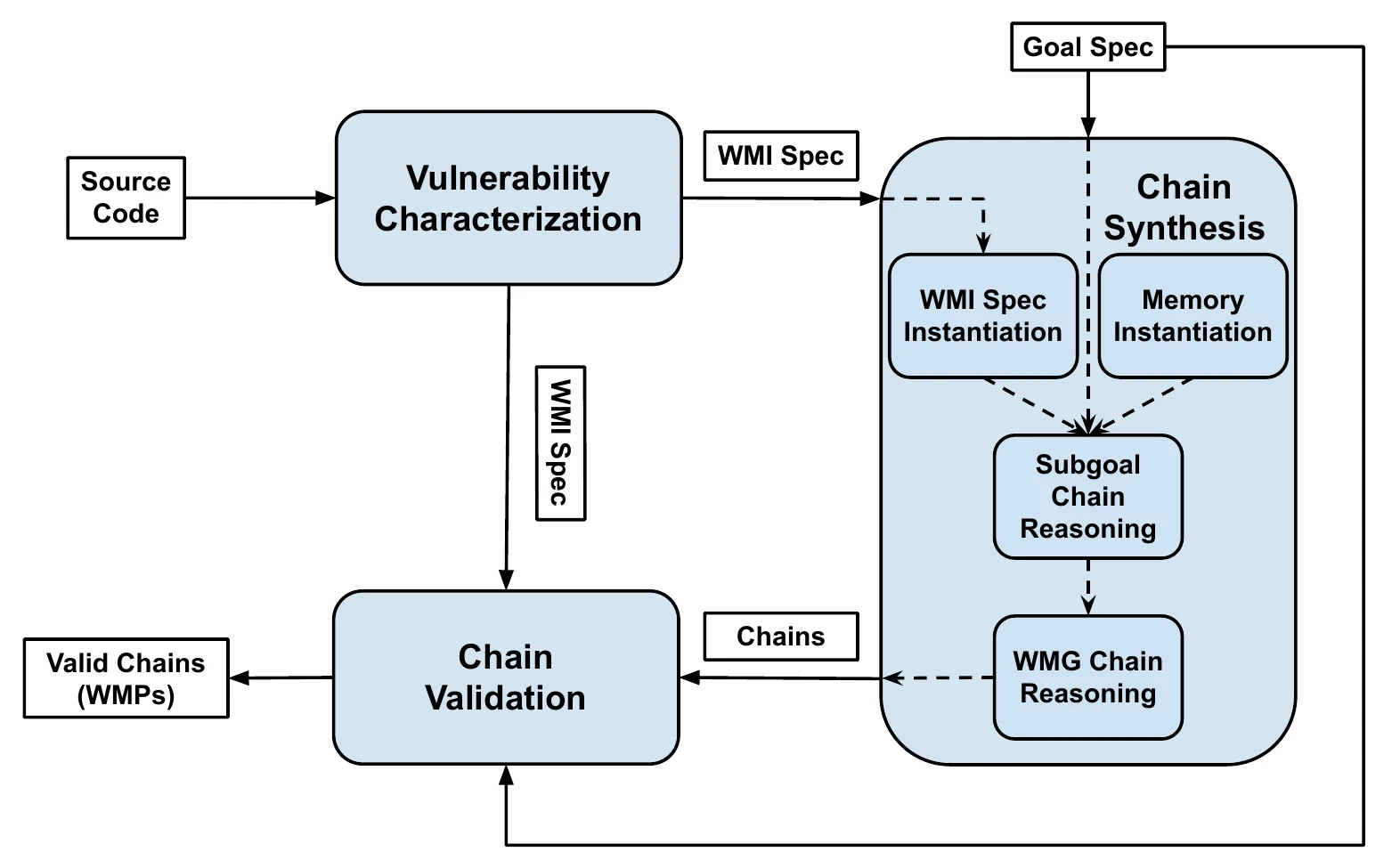
CHAINER starts from a high-level attack goal such as arbitrary code execution, and splits it into sub-goals that can be checked against memory effects. Vulnerability characterization builds on STASE and records, for each bug, the symbolic conditions that trigger it and its memory effects by segment, such as stack, heap, or SMRAM. Chain synthesis instantiates those specifications with concrete memory information and uses SMT queries to prune combinations that cannot satisfy the goal. Chain validation then replays the surviving chains in a goal-directed symbolic execution, and emits a chaining signature that captures the memory layout and linking constraints needed for exploitability.
Results
On seven challenge sets from DARPA HARDEN, CHAINER narrowed 121 candidate chains to 13 validated ones, 7 in the Linux kernel and 5 in UEFI firmware, plus one user-space chain in OpenSSH. The false positive rate falls stage by stage, from 89% for naive candidates to 0% after symbolic validation. Neither baseline fuzzing nor plain symbolic execution found any of the 13 chains. Memory-aware reasoning costs time, about 65 seconds per entry point against 56 for STASE, and the expensive validation runs only on the small set of chains that survive the earlier filters.
This work is not yet published. The numbers above are from the current draft and may change before submission.