


Bug Composition
Triggering Multiple Bugs with Agentic Driver Generation
Attackers chain bugs. Most tools find them one at a time. Bug composition asks whether one input can trigger several distinct vulnerabilities in the same execution, which is a first test for a possible exploit chain.
Workflow
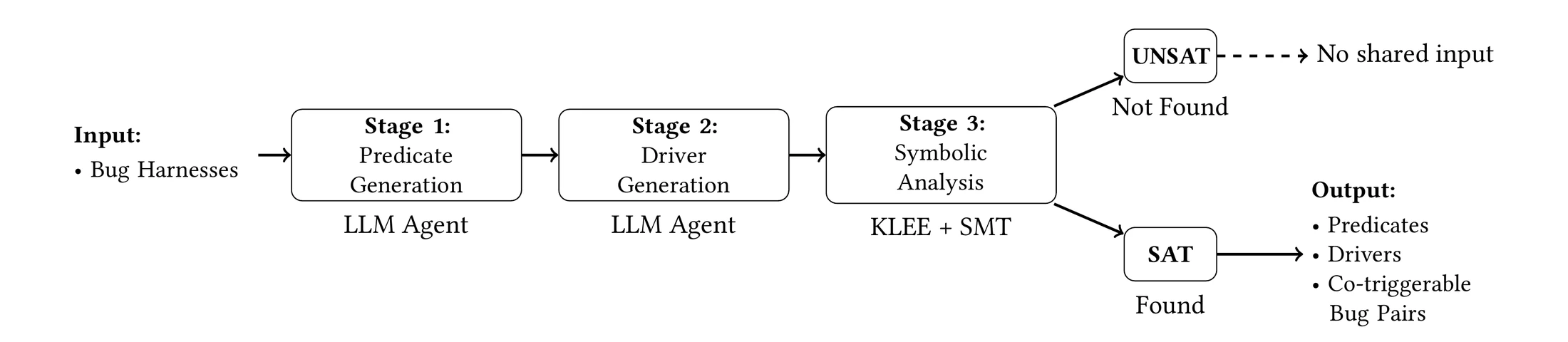
Given harnesses for two known bugs, an LLM agent first writes a predicate for each bug. A second LLM stage writes a driver that applies both predicates to one shared input. KLEE and an SMT solver then explore every combination. A satisfiable result yields a concrete input that triggers both bugs. An unsatisfiable result proves that the bugs need mutually exclusive inputs.
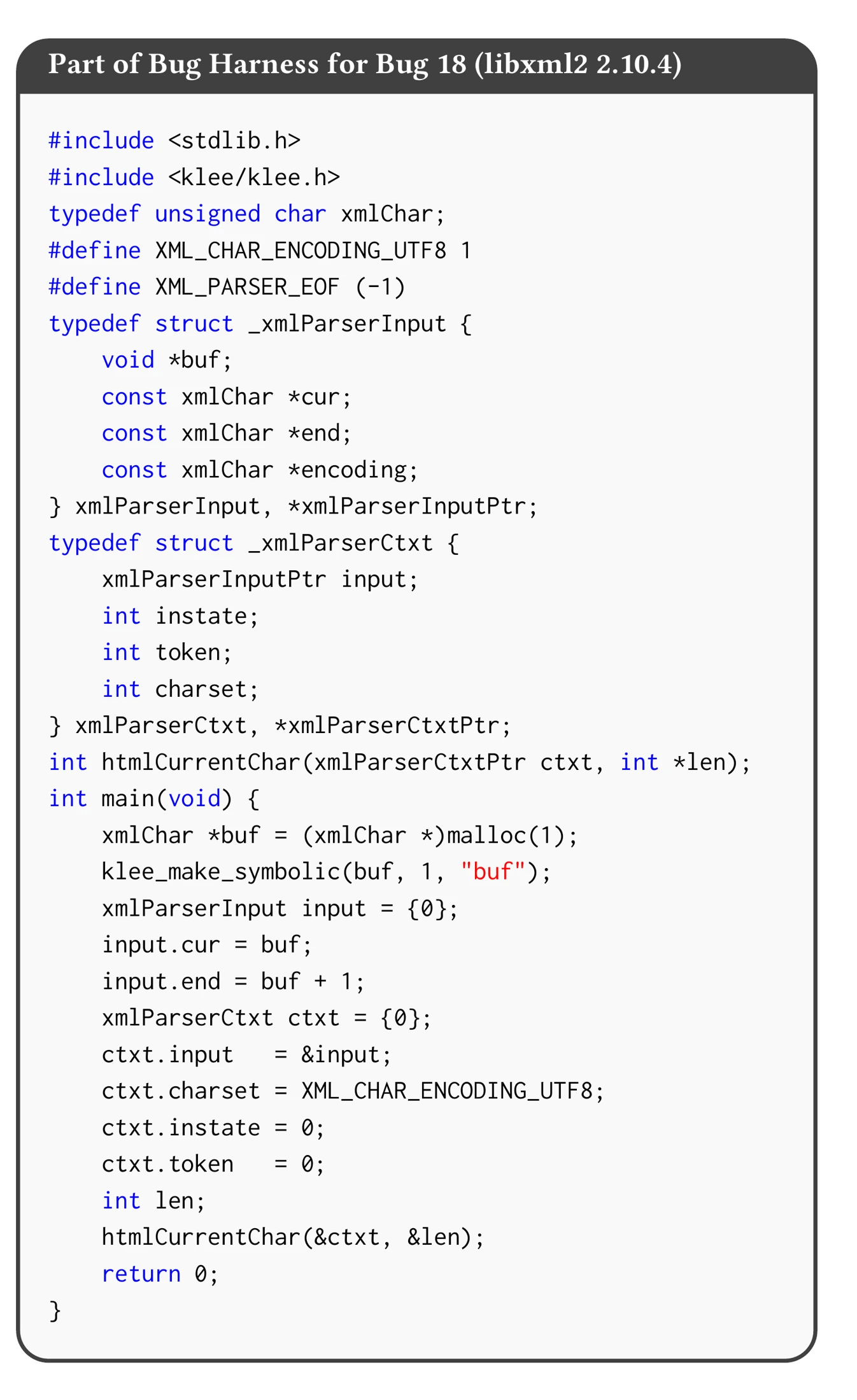
A concrete driver
The driver for a libxml2 bug pair shares one buffer and one length, couples the length to the bounds so that KLEE has to find a value satisfying both bugs, and ends with an assertion that makes KLEE produce a concrete witness.
Results
The pipeline produced concrete shared inputs for bug pairs including heap buffer overflows in tcpdump, stack and heap memory corruptions in libxml2, and out-of-bounds reads across independent protocol dissectors in nDPI. It also proved the absence of shared inputs when bugs require mutually exclusive constraints.
Mentorship
The work grew out of a mentored research cohort at UC Santa Barbara. Three undergraduate students are co-authors, and the paper is their first peer-reviewed publication.